Various ramblings and musings on gardening, agriculture, food and related subjects.
Tuesday, March 27, 2012
A Soap Opera for Gardeners
Dig, Plant and Bitch - the Soap Opera for Gardeners
Meet Petunia Martin, creator of Avalon Gardens and her neighbours Archibald and Rose Watkins-Smythe up at the historic garden of Mere Castle. Meet their respective gardeners: Bonzo the ex-heavy metal roadie and born-again Johnny Dalton, a local nurseryman or two and a cast of other colourful characters such as the village herbal healer Catkin Moonspirit and imperious garden school guru Marguerite O’Halloran.
A story of gardening rivalry, a comedy of manners on the age-old theme of old money versus new money, and a source of horticultural information, Dig, Plant and Bitch is a soap opera style story which will unfold through a series of episodes available on Amazon for Kindle, iPad and smartphone reading. It will be funny, planty and sometimes a little naughty.
“This is brilliant...I couldn’t put it down” Juliet Roberts, Editor - Gardens Illustrated
You can start reading now...
“Do you realise that when you give someone a bunch of flowers, you are giving them a bunch of sex-organs” bellowed Wayne Martin after James Treasby as he stepped outside with Wayne’s wife Petunia. “Ignore him” said Petunia, “he always makes that joke to everyone who comes round to see the garden, even the old ladies.” “I can see the garden isn’t quite his thing” replied James. “That’s right” explained Petunia, “although he’s very proud of what I’ve done, and as we get nearer to opening it properly, I mean for ourselves, not just for charity, he’s getting kind of interested.” “Ah” said James, “he sees the business potential.” “Absolutely’ replied Petunia as she stopped, to breathe in chill autumn air - it felt like the first cold day of that year’s season of decline and mellow fruitfulness.
Petunia had taken a few steps out of the house, towards the top of a gentle slope, where she could look down over the garden she had begun to create ten years ago. She had known next to nothing about gardening when she and Wayne arrived here, both taking a distinctly early retirement. Now, here at the place they had called Avalon Gardens, there were sweeping rivers of grass, broad borders of perennials, and young trees just about big enough to give a first hint of their future prime. Everything looked established enough so that those who knew as little about gardening as Petunia did when she came, would turn to her and say “what, only ten years, it looks like its always been here.” That always gave her a warm glow of satifaction.
James stood, somewhat nervously, a few steps away from her. He generally carried about him an air of brusque and superior confidence, but he found it difficult to keep it up when he went on a ‘by appointment’ garden visit like this. Owners of large gardens, usually people of wealth, social status, or success, rather intimidated him. Especially, when like today, he had not actually made the first move. It had been Petunia who had rung him, catching him unawares and feeling tired at the end of a long day at his nursery business, Treasby’s Plants of Distinction. “Petunia Martin” the voice had announced at the other end of the line, “you know me, I’ve bought plants off you, quite a few times”, she had waited long enough for James to grunt some sort of assent and recognition, “you know I’m making a garden, quite a big garden, I’d like you to see it, you haven’t seen it, have you?” James admitted he had not, and felt immediately embarrassed, as he knew that his failure to visit one of his best customers who he knew to be quite ambitious in her garden making, was almost a failure of etiquette, to say nothing of failing to take full advantage of what might be a good business opportunity. “I, I, I’d love to see it” he stammered, “really would.” “Oh gooood” replied the rather squeaky voice at the other end of the line, “oh goodie”, and dropping to an almost seductive huskiness, “and I want to ask your advice about things.” A time was agreed and Petunia had rang off, leaving James clutching his cordless receiver in a cold sweaty grip. He wondered what sort of advice she might want. After all, she was a regular at Marguerite O’Halloran’s garden school ‘Ranunculus’, where the redoubtable Mrs. O. supplied the local gardening ladies with all the advice they could possibly want, whether this advice was requested or not.
Read on ......
UK readers can get it here
North American readers here
Friday, March 23, 2012
A jaunt to Guernsey
A whistlestop trip to Guernsey to do an RHS regional lecture for Floral Guernsey. The island once had a thriving horticultural industry (cut flowers, tomatoes, veg) but now rather sadly reduced although the Raymond Evison Clematis empire is the bright spot. Lots of derelict glasshouses (reminded me of post-communist Bulgaria in the 1990s). Otherwise thriving. A very mild climate so enormous camellias everywhere and lots of exotica. Giant echiums have clearly naturalised. A lot of good gardening going on, but no 'great gardens' - this is not Cornwall, but fantastic scope for interesting planting on a small scale. I went to one private garden which I loved, Jane and David Russell's Mille Fleurs. They live at the top of a slope with a borrowed landscape of woodland and a resevoir.
It felt very tropical, not in an overt self-conscious way, but in lots of little touches like having a Clematis armandii growing into a tree, which could have been a hoya in a tree in southern India.
Shady, woodland, a lot of it, with a ground flora of primroses and lots of interesting self-seeding - all very un-English, even palm Trachycarpus fortunei self-seeding. A tree fern draped with epiphytic ferns (they arrived with it form Aus) - again, I felt i could have been in India.
The lovely Luma apiculata thrives and self-sows too. If humans suddenly disappeared from here, the island would rapidly cover in exotic woodland I am sure - like Tresco in that way.
Loved this treatment of the patch you don't want to mow or to have grass around a tree.
And with minimal frost (if lots of wind) you can grow giant aeoniums on the dustbin box, and hardly ever need water them. Some Narcissus 'Hawera' in here too.
Thursday, March 15, 2012
Dialectic of the polyanthus
So much of human life is a forwards and backwards process. Hemlines famously go up and down. Politicians react against policy A by adopting its opposite, position B, the next lot then compromise on position C, and so on. The German philosopher Georg Hegel called this the 'dialectic' arguing that this is how the human spirit drives history forward. Karl Marx adopted it as the driving force of history, but in a materialist, as opposed to spiritual way. (That's enough philosophy for today - Ed.)
I am glad to see that the humble polyanthus obeys the dialectic. Indeed it illustrates it perfectly.
I've always loathed the lurid colours of the little pot plants that every filling station in the land seems to sell, never mind the garden centres. Jo always sneakily buys some. Every year I am sure the flowers get bigger - to the extent that I wonder when the physiological limit of flower size will be reached. For years now the colours are not only bright but very flat. This year however, they are getting a wee bit more subtle - see picture above.
In the past, lovers of cottage garden plants grew named polyanthus varieties, but they have to be propagated from division and many are slow to bulk up and over several centuries of cultivation, most have been lost. I remember when i first came across Carol Klein (she of UK garden TV fame) it was as someone who grew old double polyanthus. Then along came microprop and they were everywhere, but now they seemed to have disappeared again.
What is interesting now is that the big breeders are producing seed strain for mass production in the 'older' colours and so much more subtle. An example above - which is just a big-flowered primrose really (more yellow than in the pic).
This is the old variety 'Garryade Guinevere' (not sure of spelling) which has clearly been genetically souped up for seed production and sold as 'Woodland Walk'. I must say i really like them, the dark leaves and flower colours of the old variety, but probably more vigorous.
The reaction against bold brassy polyanthus (thinking of Hegelian dialectic now) often involved growing the Barnhaven strains, bred on Vancouver Island in the 1950s, and now grown by a British couple in Brittany. I've grown them for years as they were so much nicer than the mass-produced ones, and some of the colours and combinations have incredible depth, One strain they did was a sort of denim look with a stripey look. Now it appears as if one of the big commercial breeders has got hold of it and enlarged the flowers to produce varieties like this above.
And of course the ultimate example is of the gold-laced polys, which have now been mass-produced too, for several years, when once they were really special - the only way you could get them was growing your own from Barnhaven seed. In Victorian times, these were the most widely grown of all flowers, there were thousands of named varieties, all now lost, but still represented in the wide range of flower colours.
So, the to and fro of fashion in commercial production of polyanthus illustrates well this basic see-sawing in human affairs.
Finally, if you are a glutton for intellectual punishment, you can read up on Hegel here. If you have ever had to struggle with academic German, or its equivalents as produced by east Europeans during the communist era, you have Hegel to thank.
Check out the world's first gardening soap opera - Dig, Plant, Bitch.
Wednesday, February 22, 2012
A museum in one's life
| January was stocktaking the collections time. |
The Garden Museum used to do a very good plant sale. It still does have a spring plant fair (this year - Sunday 29th April 10.30 to 4pm) but I find it hard to believe it is quite as good as it used to be. In the days when I had my nursery (1986-1992) I used to be one of the sellers. The doors would open and it was like well-heeled locusts descending. You would sell everything, in what felt like a matter of minutes. The van went back empty, your pockets bulging with big rolls of notes. I remember Carol Klein always came as well, usually late and all-over-the-place but with fantastic plants that everyone loved. I remember it was the only time I met Graham Stuart Thomas, an old man with the famous buttonhole (although I can’t remember what the flower was).
The museum bumbled on in the way that things do, and then they got a whizzy new director, who shook things up a bit, and the place has never looked back. Once run by the sort of well-meaning, well-off, but basically rather ineffectual people who run so many things in Britain (including usually, and most unfortunately, the country itself), times changed. It stopped being the Museum of Garden History and became the Garden Museum, which signaled that it was not just about the past but the present, a place to discuss the contemporary significance of the garden. New exhibitions sprouted, an elegant piece of Swiss-designed blonde woodwork cleverly made a bit more space without as much as a bolt into the listed building walls. Lots of dynamic young staff appeared. Things happened. And continue to happen.
One ‘thing that happened’ was Tim Richardson and myself being asked to put on some evening events - the ‘Vista Evenings’ were born. The event has a sort of literary festival feel, with Tim and myself questioning our guest/s in front of an audience. We’ve had some great evenings discussing all sorts of garden and landscape related issues. A bit like running a private dining club, as we all sit down afterwards at a big long table like monks (we are in the nave of a church by the way). We've had many memorable speakers and evenings, but the image that stays in my mind is that of Isabel and Julian Bannerman sprawled over a gravestone in the churchyard after one evening, the stone glistening with spilt wine, puffing away away on their Gauloises. Or the evening I was driven back through deep snow with Penelope Hobhouse and a neighbour of hers after a fascinating but freezing evening when she had been our guest.
Being in a church involves various compromises which give the place that atmosphere of genteel discomfort and inconvenience which adds idiosyncratic colour to so many British enterprises. The dynamic young staff are all squashed into a windowless cryptlike room, like so many sweatshop workers, there is a tea/coffee machine on top of an ?eighteenth century tomb, the director’s office is reached by entering a door worthy of Professor Dumbedore at Hogwarts. It can be cold, which puts us off having Vista during the winter months. But I don’t think anyone would want to trade the church in for a ‘proper’ musuem building. And there is more to come, with a building for an archive to be built in the yard outside.
Oh, there is a nice little garden round the back. And intriguing planting out front. Drop in the next time you are ‘in town’.
Friday, February 17, 2012
Garden on a windowsill

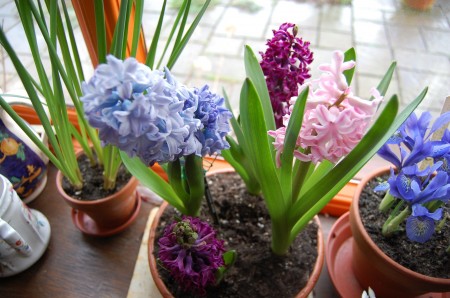
The January to March period in Britain is pretty dreary, its the dark getting you down as much as anything. Flowers growing on windowsills can make such a difference, and given my growing interest in bulbs, there is huge scope for making the most of light windowsills. We’ve got a nice long south-facing one in the kitchen which is ideal. The classic one is the hyacinth which we always get started in September to try to get them to flower for Christmas. Well, not managed that yet, but some started performing in January. The scent is fantastic and they last for weeks; and there are some good new colors too, like dark purples.
Read more...............
Tuesday, January 31, 2012
Working Weekend at Hummelo
So, the endless ribbon of the New York High Line (note always to myself, not Highline) winds along the computer screen (a Mac of course), lots of projects in Netherlands now: waterfront in Rotterdam, some private gardens (good that the prophet is recognized in his own country) a park in Stockholm for public housing, a temporary planting at the Serpentine Gallery in London, for the Venice Biennale, a vast private garden on Nantucket. Ideas and new ways of combining plants constantly roll out onto big sheets of paper - there’s a discarded one from the pile by the studio woodstove on the windscreen of my car right now holding off the vicious Dutch frost. Ideas, ideas, ideas, plants, plants, plants. I have to find the words, words, words.
This time I brought along Ye Hang and her husband Jingyu Cai. Ye is one of James Hitchmough’s doctoral students from Sheffield. She wants to translate our books into Chinese, but she has turned out to be so much more, a real third member of the team on picture selection. She has a good eye and is not afraid to speak her mind, the three of us take votes on pictures sometimes and take turns out-voting each other. Piet clearly thinks she is good and its nice to see him listening to her suggestions. Ye is the confident, creative, ambitious, commercial few face of China, full of plans for what she wants to do: a landscape company to do naturalistic planting, teaching, even a nursery in Jingyu’s home town on the North Korean border, where the local flora is apparently fantastic and hardly explored.
The Oudolf studio is a new brick building, lovely high ceilings, plenty of light and space. There are some additional rooms, which can accommodate guests like us if need be, and a little kitchen - all very much like our own annex building in concept but contemporary rather than eco-. The room I’m staying in has some of Piet and Anja’s collection of Bloomsbury group ceramics and a wonderful Caucasian rug I remember Piet getting as payment of a job many years ago.
The studio is increasingly becoming inhabited by ‘designer toyz’ - limited edition characters inspired by graffiti, comix, manga and other manifestations of urban street art. A whole new world to me. Its as if here, in the quiet and open countryside of eastern Holland they represent the gritty urban reality of the NYC and Chicago streets where Piet’s planting projects make a real green impact. I half wonder if they come alive when we turn the lights out.
Wednesday, January 25, 2012
Winter weeding
Weed control is what actually dominates my garden management. The west of Britain has such mild winters that many wild pasture grasses and things like creeping buttercup can grow almost all year round. If you live in the country chances are you'll have a massive 'weed seed bank' in the soil, so any soil disturbance brings up more seeds to germinate. Long-term, perennials form good solid clumps which tend to be weed-resistant and undisturbed soil develops a layer of moss which seems to reduce weed seed germination. At this time of year in the border, you can see some early Geranium phaeum and G. endressii growth and some evergreen Liriope, but the green haze is germinating grasses. Now is a good time to get on top of weeds, and then the rapid growth of perennials in spring will soon form a good solid canopy.
Seedlings of I'm not quite sure what - perfect for flame-gunning.
If we have a few days of dry easterly winds thats ideal conditions for hoeing, but at any other time round here hoed off weeds just root back in as it is either so wet or humid.
In the end, as plantings mature, the range of weed seed in the top layer of soil gets exhausted, and gradually increasing clumps of herbaceous dominate, so it becomes less of a problem, but I think I've still got quite a few more years of serious weed control yet.
For those who don't garden in an Atlantic climate, you probably have no idea how quickly or how comprehensively pasture grasses can take over and completely suffocate all other plantlife, apart from brambles (their co-conspirators in garden overwhelming) and decent sized woody plants. Even let loose into other climate zones they can do a pretty good job of eliminating other plants too.
Some years ago I did experiment with growing perennials in rough grass, but the fact is that very few species will co-exist, primarily because of the ability of Atlantic climate grasses to grow at any temperature above freezing. I still do have an experimental area for this, but for the rest of the garden, it has to be serious weed control.
Subscribe to:
Posts (Atom)