Friday, February 22, 2013

Nature improved upon in hellebore heaven


This almost-black hellebore looks like something straight out of a Victoran funeral. Of all black flowers they have to be the best
A wonderful day spent at Ashwood Nurseries in the Midlands, looking at hellebores and being more impressed than ever by their breeding programme but also by the plant itself, which seems to challenge and transcend our notions about the difference between the wild and the bred. This is their mother-plant greenhouse, where the plants are grown for the hand-pollinated seed. Seed to saleable plant is three years - unlike the one year of most perennials which are sold.

We are used to heavily hybridised plants looking very different to their wild ancestors, and making a big distinction between the two. Those of us who go for naturalistic planting tend to look askance at heavily-bred plants, but with hellebores it is somehow different. Here are plants which work very well indeed in naturalistic planting schemes and are not highly-strung cultivation-dependent like most intensively-bred groups. No do they have the mutant-with-a-cultivar-name look of many either. In fact they do not have cultivar names - and this is very important. They have broken free of the tyranny of the identical cloned cultivar trap which ornamental horticulture has got itself stuck in. Genetic variability rules!
Kevin Belcher cross-pollinates selected plants from mid-January. Hopefully not too many bees sneak into the glasshouse to wreak genetic havoc. Very simple crossing procedures. Everything is recorded but there are no complicated genetics here. This plant breeding is at the first level, where intuition is everything.
This is one of the 'Neon' strain, with yellow and apricoty colours predominant. The naming of particular genetic lineages which express particular colours is the nearest Ashwood get to giving names. The variation from one flower to another is one of the things which is most entrancing about them; looking at the plants in their sales glasshouse, thinking about what to buy (needless to say they are amongst the most expensive of perennials); spotting the little differences between two flowers which at first look identical - this is all part of the joy and you wonder why we are so hung up on the concept of the cultivar, where every individual must look the same. Clonal cultivars seem just so boring by comparison.
The doubles are beautiful but most of us are not so sure. For one thing the flowers are so heavy they hang down and are not so easy to see. And they do rupture that fundamental belief we have that they are not natural and there isn't one just like this in a wood in Croatia somewhere.
Single hellebores look - well, so natural. They are indeed not so far from their ancestors which are very common in the woods and meadow edges of the Balkans. Above all, they are so robust, long-lived plants which in our gardens in Britain at any rate, are very easy-going about where they grow.
The dark ones are the most vigorous by far, and look best when backlit. At our last house we had them on top of a wall so we could look up at them. A few years ago I planted out some of the many seedlings which were sprouting around the plants I bought from Ashwood 14 years ago. The ones which grew really fast all turned out to be red. However good plants did tend to produce good children, there was not much reversion to inferior forms.
I love spotted flowers. The level of spotting is highly variable. Early Ashwood spotties were red on white - they now have a strain with red on yellow.
And now there are double spotties.
The blacks are really special but difficult to use in the garden as they merge with the background. I like to plant snowdrops as contrast, and later on, dark-leaved Lysimachia 'Firecracker' makes a nice complement.
All of the ones so far are H. x hybridus, derived mostly from the very variable Balkan H. orientalis.
This is one of the x sternii group, where there is a lot of active breeding amongst several nurseries. Different hellebore species do not necessarily cross-breed (yet - someone will crack it one day, with a lab technique like 'embryo rescue', the plant equivalent of test-tube babies. At the moment varieties with good flowers tend not to have great foliage and vica versa, but I am sure this will change. There are so many species to play with. 


Monday, January 28, 2013

Beyond 'nature as virgin – garden as whore'.

Nature in the city has gotta look pretty. The New York High Line


In a recent, and well-argued post, fellow blogger Thomas Rainer quotes landscape architect Martha Schwartz as saying that “Americans treat nature like Victorians treated women: as virgins or whores”.

I know what she means: landscapes are either wild or they are not, and not-wild-landscapes in the US tend to be treated in a way which is almost abusive – the sadistically-mown grass and cruelly-clipped evergreens. Thomas though is interested in the nature side of the quotation – that “if nature (OUT THERE) is not some pristine wilderness, then it’s not nature”. As he points out there is very little pristine nature left.

All this is part of a discussion about a very thought-provoking book (Rambunctious Nature by scince writer Emma Marris) which I raised in a blog last year. I'd like to carry on the conversation.

Thomas announces that “now is the era of the designer”, that landscape designers will have an increasingly important role in designing nature, that “(t)he ecological warriors of the future will be gardeners, horticulturists, land managers, Department of Transportation staff, elementary school teachers, and community association board members. Anyone who can influence a small patch of land has the ability to create more nature. And the future nature will look more and more like a garden.”

Too right. Which raises all sorts of questions about “what is nature?”, “what is a garden?”.

They are liking it wild at last! - changing public perceptions of what a garden is
Increasingly people are appreciating gardens and public plantings that are far wilder than anything that would have been acceptable in the past. The New York High Line is probably the best example of that. Nature in the city is now seen as not just ok but highly desirable. At least in the industrialised world (it'll take a while to catch on in China!). Managing nature in the city involves habitat creation and management which is a kind of gardening. This is not actually that new – the Dutch have been doing this since the 1930s in the parks of Amstelveen.

Recently, on a trip to South America, I saw what garden designer Amalia Robredo was doing with her land in Uruguay. A lot of her 'gardening' is actually land management – deciding what to cut, when to cut it, on the basis of aesthetic decisions (to encourage spring or summer flowers for example) or functional (such as short-grass around seating areas to discourage snakes). Increasingly this land management will be seen as part and parcel of normal garden practice. Part of the reason for this is that more and more of us are gardening places which used to be farmland, but which is now uneconomic to farm; Amalia's land used to be rangeland, my own here in the Welsh borders used to be sheep pasture, and before that, arable crops.

BUT - people like their nature stylised
Especially in urban areas. Hence the incredible success of the Dunnett and Hitchmough Olympic Park plantings in London  and of course the High Line. There is nothing wrong with this, so long as people realise that this is 'enhanced nature' or 'stylised nature' and not the real thing. Given how difficult it is to actually see the 'real thing', it is probably more important for us all to realise that what we are looking at may be a fantastic wildlife habitat, but that there are a whole lot of species (mammal, bird, primarily) which will not choose to live here, because they need bigger territories or need to be well away from humans. The ReservaEcológica Costenera Sur  in the middle of Buenos Aires for example is never going to have any jaguars, nor the NY High Line any mountain lions.
A point that Emma Marris makes in Rambunctious Nature is that this stylised nature offends some people, the 'ecologists' who are still wedded to the idea that 'nature' is something which can only happen 'out there' and untrammelled by us (Martha Schwartz's virgin/whore dichotomy). The central thrust of her book is that 'nature' should be seen as anywhere where natural processes have at least some leeway; certainly including the weedy waste ground at the end of the road.

Anyway, what is nature?
An awful lot of what we think of as 'natural' is actually human-managed, or human-impacted. This was one of the points I was trying to make from Bolivia a few weeks back.  So many cherished landscapes are actually farmland, or were trashed by our ancestors. Some human management actually improves biodiversity (a heretical thought for eco-purists), as in European hay meadows or fire-managed Midwest prairie and savannah.

Eco-illusions
One of the most insidious illusions of a particular romantic and often quite techno-phobic way of thinking is that our ancestors: 'traditional societies' or 'indigenous peoples', cherished nature, lived in balance with it, and we are somehow different. Hardly. We just have more destructive tools. Our ancestors consciously manipulated nature or made huge impacts on it in many different ways (again see the Bolivia post). These ways are sometimes so deep in the past that we are not aware of them – we do not even know what 'nature' is.
  • Fire – some areas have had millennia of burning for game management (much of the grasslands of the Americas, Australia, Scotland)
  • Mass extinction – our tribal ancestors wiped out wildlife on an epic scale, with the Maori killing of the giant moa birds in New Zealand simply one of the latest episodes.
  • Farming – whether through slash-and-burn or more sophisticated methods, vast area of the globe have been cultivated at some stage.

I believe it is important that these illusions make it very difficult for us to appreciate the history of our wild and not-so-wild places, and therefore complicates the task of how we think about managing them in the future.

Farming, and more eco-illusions
Ok, we want wild: we like it, and we want it because we have finally recognised that the rest of creation has a right to life, liberty and the pursuit of (whatever passes for happiness in a newt's brain) as we have. We are getting used to the idea of nature in cities, and gardens, and that we can garden in such a way as to maximise it. We want nature reserves and national parks and wilderness areas – the latter probably as much to feed our own illusions about the 'wilderness' as actually to protect nature. And many of us would actually like a lot more for this kind of nature than there is currently is. We like to hike in it, birdwatch in it, see in on telly in David Attenborough programmes, above all to know it is there.

But.

There is an awful lot of us, and we are getting more, and richer, and when people get richer they demand more food, and more cotton, and palm oil and all the other stuff that consumer-humans want.

And the biggest destroyer of unmanaged landscapes is the agriculture which produces all this stuff.
Which is why we need to ensure that agriculture uses land really efficiently. This is something which again attracts lots of feel-good sounding eco-illusions. Many of the so-called sustainable farming approaches, such as organics, may be good and appropriate for marginal regions but fail utterly to deliver the sheer volume of calories needed. It is right and proper that fertile flat places are used for intensive arable production – with some areas set aside for nature of course. They can take the pressure off more biodiverse, more vulnerable habitats.

In thinking about how we 'garden the earth' I would suggest that this is the biggest blind-spot many people have – the failure to appreciate how efficient farming and nature conservation actually dovetail. Think of the earth as a garden, with a well-run tidy vegetable patch, a lawn area to play on, some nice wild borders and a really wild unmanaged bit somewhere.

The nation as garden – the Dutch analogy
'Gardening the earth' – was an expression I dreamt up years ago, in a essay for a collection in a book called Vista – Culture and Politics of Gardens. 

It is interesting to develop this analogy: we need places to grow food, to live, and for nature. The Netherlands seems to have come pretty close to this, with its very dense juxtapositioning of land for living, working, recreation, some of the productive farming on the planet, and yet with a long and pioneering history of habitat creation, and one of the most radical departures in wilderness creation – the Oostvaardeersplassen.

We have far more to thank those sensible, level-headed Dutch for than just tulips!

Nurturing nature
So, we are getting used to the idea of the earth as a garden. Often badly managed by us, and by our deep ancestors, for sure, but as we learn more about our ecological history, and about ecological processes, we can become better managers. We need to. As we are just about to reach a point where designed vegetation will play a vital role in how we manage the planet.
In April Piet Oudolf and I are bringing out another book – on planting design. The introduction however makes the point that we are expecting plants to do more and more for us: wetlands to manage sustainable drainage systems, green roofs to moderate the extremes of urban climates, bioremediation planting to purify effluent, living walls to clean the air. Managed vegetation will play a more and more important role in reducing the impacts of climate change, and might even help reverse the rise in CO2. Nurturing nature will not just be about creating habitat, but about planet-management too. As we nurture nature it in turn will nurture us.

Saturday, January 19, 2013

Back Home and Clearing Up, and thoughts on crimes against perennial growing.

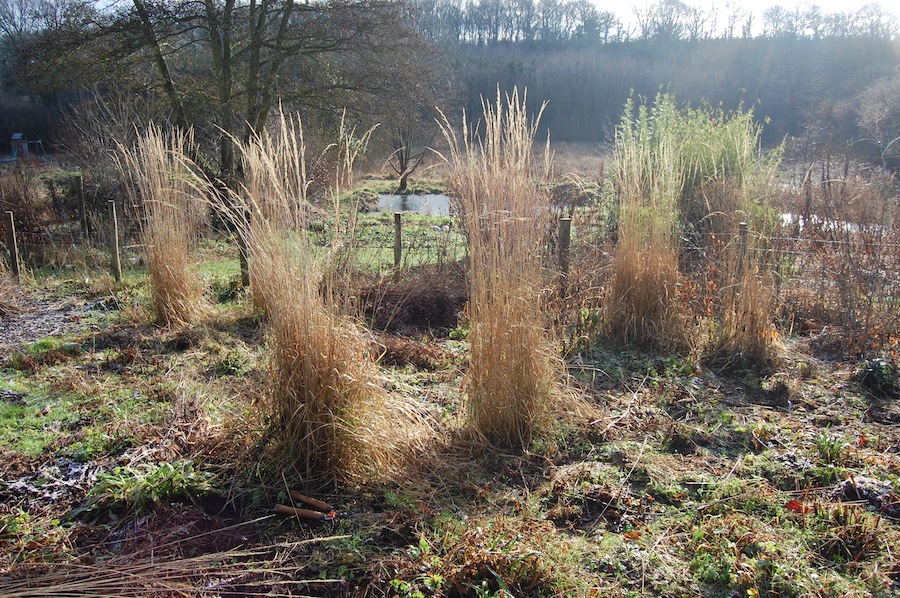
Back home from two months away in South America, and there is a lot to do the garden, although our one-day-a-week gardener, Diana had got a lot done. Cutting back primarily. Usually I cut back most of the messier herbaceous stuff in November, leaving grasses and a few of the stronger structural elements.


Until late January or Feb. But this year, I thought I'd get rid of the lot in one go. On this border, dead stuff ends up on the compost heap - on others I am inclined to cut it all down with a brushcutter and leave to rot down in situ. Some folk go over it all with a mower on a mulch setting, but mine won't do that, so it just stays as a rather heavy mulch. This border, we do not rake up what we don't carry to the compost heap. It just has to sit there looking untidy until spring growth begins to hide it. I do appreciate how nice and neat a newly cleaned up late winter border can look, but quite honestly life is too short.
        Last week I was in the Savill Garden near Windsor. Their big herbaceous border was enough to convince me that I don't really want a nice tidied-up border after all. Horrendous! A vast swathe of bare earth with occasional perennial clumps (about one a metre in places - so many gaps!). Apparently they cut the grasses down in November - what a crime! Everything I can't stand about traditional perennial gardening all on show in one go.
       To summarise: crimes against perennial growing:
1) all composed of enormous groups of the same thing
2) all cut back at once, nothing left for Santa or anybody else visiting in winter to look at
3) huge areas of bare ground
4) so I am told.....all dug up and divided every four years, no matter what the natural lifespan of the plant is.
        Right got that off my chest! But the S Garden is magnif for its witch-hazels and (later) rhodies and other spring-flowering shrubs. One of their problems I suspect is too much money - or maybe the Queen likes it so tidy (it is hers I suppose after all). A problem which can wreck gardens through over-maintenance, and there was plenty of that on display here.


 One of the insights of cutting-back is to see perennial growth at ground level - the Rabbit's Eye View I am always on about. Phlox are interesting - some break up their clumps really quickly; traditionally they are the kind of perennial which benefited from dividing every four years; not this one though - see how tight its basal growth is after six years in the same spot. A very strong-grower, given us by a (posher than us) neighbour soon after we moved "have some phlox, frightfully vulgar pink". It is pink, it is vulgar, but oh so much better here than any other phlox we have tried. More research needed I think.
The garden here at Montpelier Cottage is more or less 'an evergreen free zone' - out of a desire to fit into the local landscape. Bamboos are the exception though, their wispy habit does not visually obtrude in the way that blocky shaped glossy-leaved evergreen shrubs do.  This is Chusquea culeou 'Weeping Form'.

Phyllostachys aureo-sulcata 'Lama Temple' looks so fresh in the snow. It has proved much hardier than some too.

Time to flag up some dates for your diary:
 I shall be in North Carolina in early March - dates see the column on the left. 

I shall be doing this for RHS Wisley on Feb.26, just before I leave for the US.

In July I shall be running a planting design workshop with Piet Oudolf at Hummelo (July 3), followed by a tour of gardens and landscapes in the northern Netherlands for Gardens Illustrated magazine, based on Groningen. Get in touch with me if you are interested in either of these.


Friday, January 11, 2013

Two hikes in the foothills of the Andes...

Two very different walking experiences in the foothills of the Andes; the first was beautiful but badly eroded scenery with only a little plantlife hanging on, the second was a tantalising glimpse into a botanical paradise.
Week before last we managed a hike in the hills around Sucre, in central Bolivia. Pretty catastrophically deforested (as is much of the whole central region of the country), but botanically interesting as always. Some surviving trees on very steep slopes, but otherwise pretty much like this.
An erosion gully, a bad sign that the whole landscape is being eaten up. I would imagine the Spanish cleared the trees for silver smelting, as we are not so far from Potosí whose silver did so much to change the world economy in the 17 & 18th centuries, as well as swallow up to (it is estimated) several million human lives.
Drought-tolerant scrub mostly survives. I think this is a white ceanothus species.
What always intrigues me in places like this are cliffs, which act as 'refugia' for native species; not even the goats can get at them, and invasive aliens tend to be held at bay too. Here grasses, bromeliads, cacti, various bulbs, begonias and much else forms a rich plant community.
Compared to the opposite bank of the river, with eucalyptus but otherwise grazed to almost bare ground. Eucaluptus is a boon for the locals, as it provides such good firewood and so helps protect surviving native species. We saw a man planking up cut eucalyptus with a chainsaw, which is normal practice here - a real precision job!
I wish I could have got the Adiantum fern and the cactus in the same shot but not quite; they were actually growing a few metres from each other with identical aspect. Which does rather challenge ideas about 'what grows where'. In fact, I think there is plentiful water on this cliffs when it rains. The fern is a 'stress avoider' going dormant in the dry season, while the cactus is truly 'stress tolerant' as it can sits out the drought.
Air plants - Tillandsia species are the great survivors. Here growing on a shaded rockface.
They are very common on electricity cables. Here in downtown Sucre.
Verbena species have popped up all over the places we have been to.
No idea what this is, but a wonderful example of evolution in action, a seemingly self-supporting shrub but with tendrils on the ends of its leaves, ready to start climbing.
Our second hike (at around 2600m) was in Salta province, Argentina, with Veronica Saguier and her family. Veronica is a local garden designer who is also a keen trekker. There is a great deal of surviving undamaged forest in the area and many other habitats. Because of the interplay between altitude and aspect it is possible to have extreme habitat changes over relatively short distances. A bit like California, where you can drive from semi-desert to mistily-dripping redwood groves within half an hour. Cloud forest (see a previous blog) covers all land at a certain altitude.

Where we started our walk it had an oddly familiar feeling... could easily have been somewhere in Europe - a gently farmed landscape. Hedgerows around where we parked, with several salvia species, a penstemon and much to my surprise a geranium (I didn't realize there were any in South America). As soon as we got going we very subtly shifted into a somewhat drier zone and so we never got to see more of the flora of the place where we parked (and our car was at the bottom). It remains as a tantalising memory to make me come back.
Thrilling to see a Bomarea species, climbing relatives of Alstroemeria.
?Bignoniaceae, small shrub.
If not a Tradescania, then very closely related, and with definite garden potential.

 Giant cacti (known locally as Cardones) are a feature of the landscape, otherwise dominated by a rich array of drought-tolerant-looking shrubs. The cacti can be home to a remarkable number of epiphytes: ferns as well as air-plants.
A familiar friend, Stipa tenuissima (correctly now Nassella) growing by the side of the path.
A Loasa species, attractive annuals which were grown in Victorian times as ornamental annuals, even though they have nasty stinging hairs.
Down by the river we come across the bottom of what was obvious from further up - that whole slabs of rock and its accompanying vegetation are slipping down off the mountainside. This particular remnant is probably all going to disappear in the next few years. It contained no less than three rather spectacular bulbous species, including a very tall orange Alstroemeria and heavily scented white lily family species. The little figure on the right here is Veronica scrambling up the slope.
Some of the bulbs were actually hanging out of the eroding face of the soil, so Veronica's husband Julio rescued some.
This is somewhere I am dying to get back to. There are very fine distinctions between very different climate zones, so several very different floras seem to sit within a few hundred metres A lot would be hardy for mild temperate climates like ours, many other species could be usefully drought and stress tolerant. I very much hope to come back and work with local garden people in a few years and so some serious plant hunting. 


Sunday, December 30, 2012

Where have all the trees gone - reading other people's landscapes, or, why does Bolivia look like Wales?

Terracing on Titicaca - but how old are they? When where they abandoned?
Walking on the Isla del Sol on Lake Titicaca – actually floundering around in a futile search for some Inca ruins, there is an uncanny resemblance to ?Cornwall, ?Scotland, ?Ireland. The distant view is of islands and headlands, so much like the west coast of Scotland, or Scilly Isles. The land we walk on is treeless hill plunging down to water. Nearly everything is divided up into little terraced plots for crops, with thick growth of low shrubby indigenous vegetation growing out of the little retaining walls. There were places in Cornwall like this in Cornwall until the mid 20th century, as people grew crops on tiny terraces. I had a very powerful feeling of being somewhere generically Celtic and British Isles west coast, but also of being there back in time. Yet we are on the other side of the world. It was an extraordinary experience.

The little figure is Jo, not a Bolivian peasant lady

I always find myself trying to read the landscape when I'm travelling. It is not always apparent quite what is going on – is this a natural landscape? Or one that's modified by human agency? Or might it be a lot more modified than we think at first possible? Reading the landscape is partly about loving natural and semi-natural landscapes for their own sake, but also about trying to interpret them: their history and what they mean for people locally. The level of biodiversity they support is of passionate interest – like many people, I travel partly in order to see places of natural beauty and biodiversity. Farming in some fashion usually impacts the landscape and the wild flora and fauna it supports. Understanding farming practices and reading their impact on landscapes, now and in the past, is crucial to an understanding of what is going on. It is also vital to help us understand how the landscape might evolve. Anyone concerned with biodiversity needs to have some understanding of farming – agriculture is the main reason why natural landscapes are modified, usually to the detriment of natural biodiversity – indeed I am tempted to say that agriculture is the dominant consumer of the landscape.

So, here I'd like to reflect on my recent travels and ask a few questions, such as: how is the landscape being used? Is it being used productively, how much biodiversity does it support? Why does it look like it does? and finally – Where have all the trees gone? And when?
Travelling by bus from La Paz to Cocacobamba on Lake Titicaca in Bolivia across the altiplano (3500m upwards), I was struck by how much the landscape looked like Scotland or mid-Wales. Come all this way and it looks like Wales! In reading other people's landscapes, it helps to be able to read one's own. The issues are often the same – people have to scratch a living from the land, technologies are similar the world over, so it is not surprising that outcomes are often similar.

This train of thought started with staring out of the bus at bleak hilly landscapes, covered in rough grass, with some attempts at arable farming in the level valley bottom along the road. The first thought is: there are no trees. But then, I see eucalyptus, big healthy eucalyptus. More about this later, but for now, it is obvious that we are not above the tree line and that if eucalyptus can grow so can other trees. Where are the native trees?

Distant view of hills - no sign of terracing, but utterly treeless, so grazed presumably
Immediately in front of above, clearly arable crops in little fields
Looks like fallow, post-harvest, but there is an awful lot of this.
-->
Let's start back home. Much of upland Britain has a similar appearance, of bleak rolling hills, covered in grass/heather/bracken. Lower elevations may conceal woodland, and on the hills (certainly in south and mid Wales) the odd hawthorn tree stands as a reminder that trees can survive. The fact is that upland Britain used to be forested, and is now severely deforested. Our Celtic ancestors made a start, and the Cistercian monks who colonised upland England and Wales finished the job, with their insatiable need for firewood and their flocks of sheep, goats and cattle. The process in Scotland did not involve monks; the deforestation process was completed by the infamous clearances whereby the indigenous people were thrown off the land for the sake of huge herds of sheep and cattle. We tend to think of upland Britain (and the Scottish Highlands) as natural landscapes – they are not, they are arguably ecological disaster areas. Their tree cover lost, they do not hold water well; the overstocking with sheep (subsidised by the EU), prevents the re-establishment of tree cover exacerbates the problem – flooding downstream is a result.
Gorse flowering on moorland, South Wales. The result of historical deforestation.
Keeping sheep is part of the culture in much of Wales and the borders. This, allied to the cachet of supposed quality attached to 'Welsh' lamb means that far more people keep sheep than perhaps should. Sheep are responsible for the ever onward march of bracken; if cattle ranching (as in similar habitat in Scotland) were more popular, then the bracken would be much less of a problem (cattle eat the young shoots and crush it, sheep tiptoe around it). My suspicion that unreflective rural conservatism plays a big part in the ongoing sheep problem is confirmed in occasional discussions I have with a local agronomist – he is appalled by the conservatism of local farmers. Looking at the bigger picture the current practices of Welsh border farming is pretty irrational.

Very intensively managed farming around the village of Challa, Isla del Sol, Titicaca.

Back to Bolivia. The terraces on that part of the Isla del Sol, and around Challa, the central village, are intensively cultivated – for crops such as potatoes, oca (an Oxalis with an edible root) and possibly corn. The fact that the little walls are so species rich means that this whole system of farming is surprisingly biodiverse – because it is arable, any animal grazing is highly controlled (i.e the occasional tethered goat). However over most of what we see, things look in a pretty bad way. There are large areas where it is actually quite difficult to see what is going on – there are rather half-hearted patches of crops, occasional grazing areas, and large areas of fallow – it is fairly obvious that everything is being grazed for at least some of the year, apart from the crops. It all looks very poorly managed. I have seen this before, in Brazil and in India.

The sad truth is that a lot of small-scale farming in developing countries is actually pretty bad. There is a lot of politically-correct sounding talk around about how traditional farmers have a whole range of techniques and crops which successfully exploit the environment without damaging it – this is usually the result of occasional examples of good practice being given a lot of publicity. I remember reading about some research the Henry Doubleday Research Association (now Garden Organic) Third World Support Group did in central Ghana in the late 1990s. They found that the knowledge and skill level of the majority of farmers they surveyed very low. So much for all that finely-honed centuries of traditional knowledge.

Overgrazing, the land in front is pretty well stripped bare, the green grass is as short as a golf course.
The brutal truth about many (maybe most) rural areas in developing countries (and in the rich world too to some extent) is that the brightest and most innovative head off for the cities as soon as they can. Back in the countryside, there is usually little to help with innovation or advice (unless there happens to be a small-farms-orientated NGO in the area). Places with government-backed education and advisory services are few and far between – one of the few is Kerala in southern India, and it is worth pointing out that none of what I say applies to Kerala, which is almost Dutch in its intense and precise land management.
There is a saying from the south of France - "grandfather had sheep, father had goats, I have nothing". Goat grazing is the most destructive of all.

There is going to be a very poor yield from these potatoes. More than anything else, it is the time involved in producing poor yields that is the real tyrany in poor farmers' lives. The Green Revolution does not appear to have reached here.

Low quality, unproductive agriculture degrades soil quality, the ability of the land to hold water, and destroys biodiversity. Poor farmers, forced onto marginal land, with few skills or adaptability, cause worse problems than modern intensive arable agriculture, which uses land very efficiently by comparison, reducing pressure on marginal land, which can be left for watersheds, forestry, biodiversity, and maybe some traditional hunting and gathering.

The folks left behind in the countryside usually work hard enough, but with a declining ability to adapt and innovate, the quality of farming and the ability to earn something from the land goes down too. The next stage in the story can be seen in much of Europe, where villages empty and much marginal farmland is abandoned (this has happened in the UK much more than many appreciate). From the point of view of both biodiversity and a healthy landscape this is often a good thing. One result is the onward march of woodland. Not that woodland is always a good thing; in some places open, traditionally-managed upland pasture supports more biodiversity – I'm thinking in particular of limestone pasture in central Europe (very similar to England's South Downs); here well-managed grazing is a very good thing.
Small-scale desertification plus eucalyptus.
In Bolivia, later on, on our walk across the Isla del Sol, we see examples of real land degradation. Overgrazing has led to a process of desertification. Occasionally, amongst the wasteland of bare stony ground and chewed-looking shrubs, someone is bravely trying to grow a few crops. One cannot but admire the hard work and gritty struggle to survive that goes into this. At the same time however, I feel that the sooner people have the economic means to give up this unequal struggle, the better for all concerned: people and environment.

Unlike the precision of arable farming, where a long-term decision not to cultivate means that at least some natural plant community gets to survive, loose grazing can be incredibly destructive. This can be appreciated by the Welsh hills and the Scottish Highlands, where stocking levels of sheep/deer are too high to allow for regeneration of trees, and where the idea of the regeneration of woodland is actually an alien one. It happens on a vast scale across many environments which are too marginal for arable farming. In Kyrgyzstan in the summer, we came across some areas where a little grazing was clearly beneficial to biodiversity, keeping areas within woodland open, so allowing for a diversity of habitats. There were some areas where there was clearly massive overgrazing, so erosion was beginning to occur – apparently there is very little regulation of grazing here. The irony of overgrazing is that the pastoralists who rely on their herds are destroying their own futures. Their reason behind such overgrazing lurking in the background, is the demand of growing populations, and wealthier populations, for meat. One big reason why I don't eat meat.
Woman working, hand weeding potatoes. Picturesque peasant but who wants to swap places with her?
Back to the question which puzzled me between on the bus ride across the Bolivian altiplano. Where are the trees? It is clearly below the tree line because of the eucalyptus. There was a related question in my mind, which was raised by Robert Peel, an Englishman who gave an interesting lecture on gardening in Argentina at the Royal Horticultural Society library a couple of years ago – the pampas supports trees, but why are there no trees there naturally, or indeed were there at the time of the Spanish conquest? No Argentinian colleague seems to know why?

Before I pitch in with a possible answer, I should point out the one feature of the altiplano hills which did not remind me of Wales or Scotland. The fact that many of the hills, far from any existing settlement, and often very high up (4000m plus), clearly had the remains of terracing, so clearly huge areas once had intensively managed arable crops. Nowadays these are only seen being actively cultivated around the villages. It looks as if this area must once have supported a population far far more numerous and denser than today.

The answer is not that they are all living in La Paz or El Alto (see my previous travel blog), or for that matter Miami (Latino-Central in the USA). I am now going to suggest that you read 1491 by Charles Mann who has written extensively on the pre-Columbian Americas and indeed very sensibly about modern agriculture. Any American reading this blog, in particular should read this. Bascially Mann's thesis is that:
  • before 1491 (the year of the Encounter, when Columbus landed) the Americas were densely populated with cultures who farmed/gardened/managed landscapes on an epic scale
  • the only comparable cultures in the Old World which could rival them in the efficiency and intensivity of their agriculture were those of China and South-East Asia
  • after 1491 their numbers were decimated by diseases inadvertently introduced by Europeans – as much as 95% death rate!
  • as a consequence, what we see looking at many American landscapes, are places denuded of their population.

Buddleia coriacea
 Perhaps this explains the empty treeless landscapes. Not only had there been several millenia of very active management, which is a polite way of saying that pre-Columbian farmers engaged in massive deforestation, but also that since the holocaust of 1491, intensive arable has been replaced by extensive grazing, so eliminating native tree species over vast distances.
Of the original species you do see very few. Two stand out: Buddleia coriacea, which has very attractive upright-swept branches with very dark evergreen leaves and Polylepis tarapacana, which has leaves which clearly point it to being in the Rose family; it actually grows higher than any other woody plant (5000m+); it has amazingly stringy cinnamon-coloured bark. Both are short, wiry and scrubby. Indeed a great deal of the woody plant species of the areas we have visited in South America seems to have this character (see previous blog – Tango at La Pasionaria). These are not species which have any economic value beyond (I imagine rather slow-growing) firewood. So, no wonder that there is little economic incentive to preserve let alone grow them, AND no wonder everyone plants eucalyptus.
It is frightening how little grows beneath Eucalyptus
Eucalyptus are everwhere. We saw vast numbers in coastal Uruguay, and there are patches all over the Bolivian altiplano areas we visited, and again on the hills lower down where we are now. It is almost sinister, and alarming, how totally the native woody plant flora has just vanished, to be replaced by this alien species.
However, eucalyptus produces good timber (unlike many locally native species) and very good firewood. Its presence will reduce the plundering of the remaining local forests; if I were a local farmer, I would plant it.
There is considerable debate about whether the Ozzie import causes environmental damage, e.g. by taking too much water out of the ground. I'll leave you with two opinions, one from Kenya and one from Ethiopia.